
Summary:
- Hysteroscopy is a safe procedure
- Minimally invasive with quick recovery
- Common side effects are mild
- Risks of hysteroscopy are rare
- Serious complications are uncommon
- Expert care improves safety outcomes
Let’s be real for a second.
When someone hears the word procedure , their mind goes straight to worst-case scenarios. I see it all the time in my office here in Chicago. A patient sits down, takes a deep breath, and asks me, “Is this safe?”
If you’ve been told you need a hysteroscopy, you’re probably feeling the same way.
So let’s slow this down. No rushing. No complicated language. Just a clear, honest conversation—like we’d have sitting across from each other.
First, What Exactly Is a Hysteroscopy?
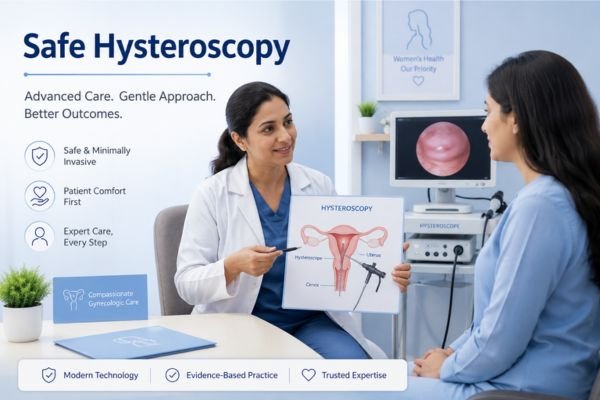
In simple terms, it’s a way for me to look inside your uterus without making any cuts.
I use a very thin camera—called a hysteroscope—and gently pass it through the cervix. That’s it. No incisions. No stitches.
I recommend this test when I need to understand things like:
- Unusual or heavy bleeding
- Trouble getting pregnant
- Polyps or fibroids inside the uterus
- Anything that just doesn’t “add up” on ultrasound
Sometimes, I’m only looking. Other times, I can treat the issue right then and there. And that’s one of the biggest advantages. One visit. Answers. Often, a solution too.
So… Is It Actually Safe?
Short answer? Yes.
Longer answer? Also yes—but let me explain it properly.
Hysteroscopy is considered one of the safest procedures we do in gynecology today. It’s done across the U.S. every single day, often as an outpatient procedure. That means you go home the same day. Most of my patients are back to their normal routine within 24–48 hours. Technology has improved a lot over the years. The cameras are better. The instruments are smaller. And that makes a big difference in both safety and comfort.But I’ll never tell you that any procedure has zero risk. That wouldn’t be honest. What I can tell you is this: The risks are low. Very low.
What You Might Feel After the Procedure
This part surprises a lot of people. Recovery is usually… uneventful.
You might notice:
- Mild cramping (like a light period)
- A little spotting or bleeding
- Feeling slightly tired or “off” for a day
That’s normal. Your body is just reacting to something new.
I usually tell my patients: “If you’ve had period cramps before, you’ve already felt worse than this.” Most symptoms settle quickly. A heating pad and some rest go a long way.
The Risks (Let’s Talk About Them Honestly)
I believe in being upfront. Not scary. Just real. Here are the possible risks, even though they’re uncommon:
- Infection – This is rare. If it happens, we treat it early and effectively.
- Uterine perforation – This means a tiny hole in the uterus. It sounds alarming, I know. But it’s very uncommon, especially in experienced hands.
- Reaction to anesthesia – Some people feel nauseous or dizzy afterward. Usually temporary.
- Fluid imbalance – During the procedure, we use fluid to see clearly. In very rare cases, the body absorbs too much. We monitor this closely.
I want you to notice something: None of these are common. And when they do happen, we know how to handle them.
The Rare Stuff (That Patients Often Google at 2 AM)
I know how it goes. Late-night searches. Worst-case stories. So let me clear this up.
Very rare complications can include:
- Heavy bleeding
- Injury to nearby organs
- Scar tissue forming inside the uterus
- Serious infection
I’ve been practicing for years, and I can tell you—these are not things we see often. And when care is done properly, with good technique and follow-up, the chances drop even further.
How We Keep You Safe (This Part Matters Most)
Safety doesn’t just “happen.” It’s built into every step. Here’s what I focus on with my patients:
- Knowing your full history – Medications, past surgeries, health conditions—it all matters.
- Clear planning before the procedure – No surprises. You’ll know what to expect.
Using the least invasive approach possible Always. Careful monitoring during the procedure, We’re watching everything closely. Follow-up after you go homeYou’re not left on your own. I often tell my patients: “It’s not just the procedure. It’s the person doing it—and how they take care of you before and after.”
When Should You Call Me After a Hysteroscopy?
Most patients recover without any issues. Truly. But I always give clear guidelines, because peace of mind matters.
Call your doctor if you notice:
- Heavy bleeding (soaking pads)
- Severe or worsening pain
- Fever or chills
- Unusual discharge with a strong odor
Don’t wait it out. Don’t second-guess yourself. If something feels off, I’d rather you call.
A Quick Word About Fear
Let me say this gently. It’s okay to be nervous. I’ve had patients tear up before a hysteroscopy. Some are worried about pain. Others about what we might find. That’s human. But here’s what I want you to remember: This is a tool that helps us understand your body better. And often, it helps us fix the problem at the same time. It’s not something being done to you. It’s something we’re doing for you.
My Final Thoughts (From One Conversation to Another)
If I could sit across from you right now, I’d say this: Hysteroscopy is safe. It’s quick. It gives us answers we can’t always get any other way. Yes, there are risks. Every medical procedure has them. But in this case, they’re uncommon—and manageable. What matters most is that you feel informed. Not rushed. Not confused. If you’ve been advised to have a hysteroscopy and you’re unsure, come in. Let’s talk. Ask me everything on your mind—no filter. You don’t have to figure this out alone. And when you’re ready, we’ll take the next step together.
FAQ’s
Q1. Is hysteroscopy painful?
Most patients experience mild discomfort similar to menstrual cramps.
Q2. How long does it take to recover from a hysteroscopy?
Recovery is usually quick, with most people resuming normal activities within a day or two.
Q3. Are complications from hysteroscopy common?
No, complications are rare, especially when performed by an experienced doctor.