
Quick Summary
You’ve been bloated for days. There’s an uncomfortable pressure low in your pelvis. Maybe an ultrasound showed something on your ovary. And now your mind has gone straight to one place: Could this be ovarian cancer? I understand the fear. I see women in my office who arrive already convinced that an ovarian cyst must mean something terrible. Usually, it doesn’t. Ovarian cysts are extremely common, particularly before menopause, and most are benign. Many appear as a normal part of ovulation and disappear without treatment. Ovarian cancer is different. The frustrating part is that its symptoms can look surprisingly ordinary: bloating, pelvic pressure, changes in appetite, constipation, or needing to urinate more often. So how can you tell the difference? Often, it’s not one particular symptom. It’s the pattern. A new symptom that keeps happening, doesn’t settle, or gradually gets worse deserves a closer look.
What Is an Ovarian Cyst?
An ovarian cyst is a fluid-filled sac that develops on or inside an ovary. If you’re still having periods, cysts can form naturally during your menstrual cycle. We call these functional cysts. Most functional cysts are harmless and disappear on their own within a few menstrual cycles.
A cyst may cause:
- A dull ache on one side of your pelvis
- Bloating or pressure
- Pain during sex
- Changes in your period
- Sudden pain if a cyst ruptures
- Severe pain if the ovary twists, called ovarian torsion
Sometimes there are no symptoms whatsoever. We find the cyst during an ultrasound for something completely unrelated. Not every cyst can simply be ignored, though. I pay closer attention when a cyst is large, continues growing, doesn’t resolve over time, has solid or unusual features on ultrasound, causes significant symptoms, or appears after menopause. The ultrasound appearance matters just as much as the size.
How Is Ovarian Cancer Different?
Ovarian cancer has sometimes been called a “silent” disease. I don’t love that description. Women with ovarian cancer can have symptoms. The problem is that those symptoms overlap with dozens of everyday conditions. Bloating after a big dinner? Common. Constipation during a stressful week? Also common. Feeling full after three bites every day for several weeks when that’s completely new for you? That’s something I want to hear about.
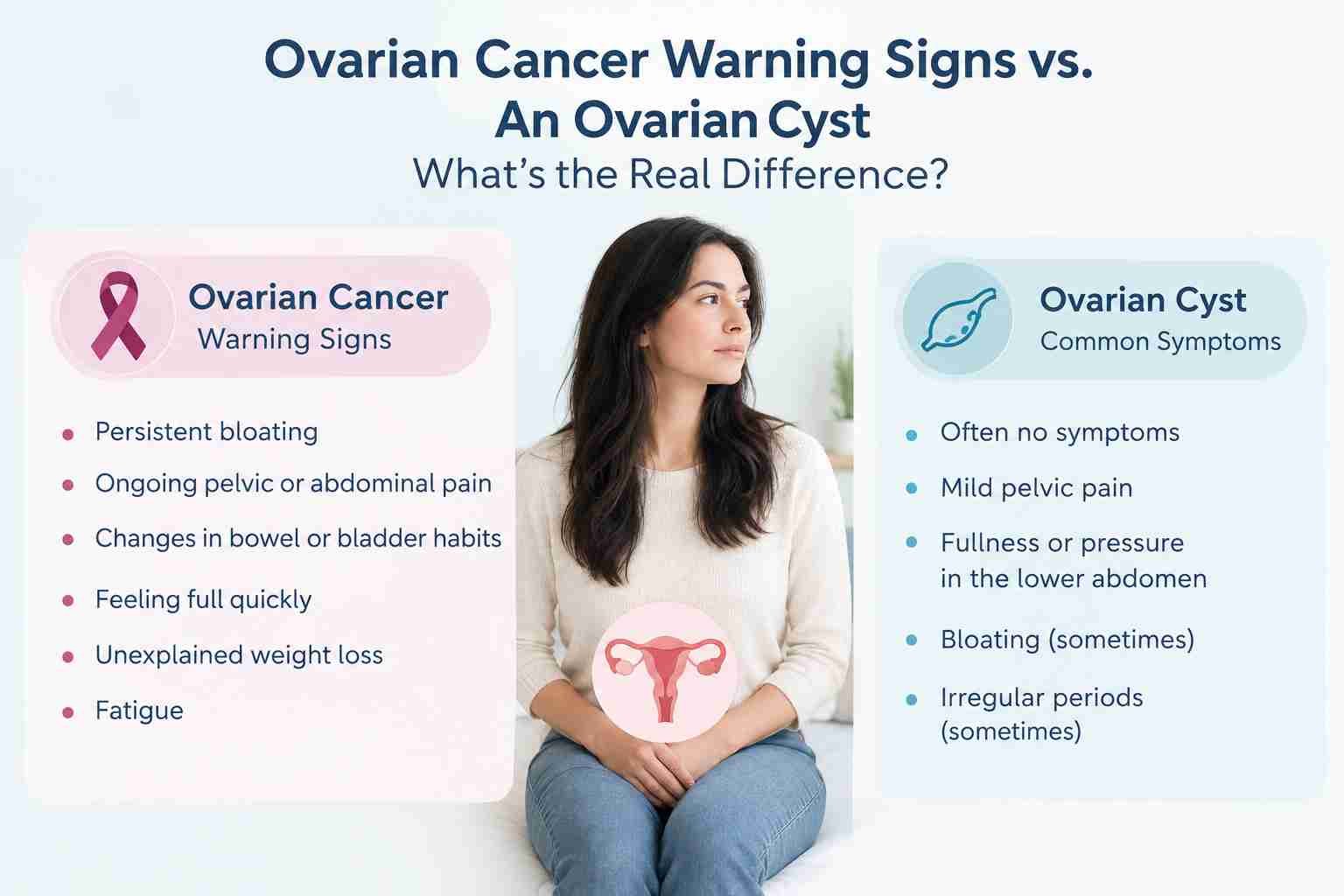
Symptoms associated with ovarian cancer can include:
- Persistent bloating
- Pelvic or abdominal pressure
- Pelvic or abdominal pain
- Feeling full unusually quickly
- Difficulty eating
- Frequent or urgent urination
- Constipation or other changes in bowel habits
- Unexplained vaginal bleeding or discharge
None of these symptoms means you have ovarian cancer. What catches my attention is when a symptom is new for you, happens repeatedly, and doesn’t go away.
Ovarian Cyst vs. Ovarian Cancer: What Does the Pattern Look Like?
There isn’t a symptom checklist that can diagnose cancer at home. Still, there are patterns worth recognizing.
| Symptom pattern | More typical of a cyst | More concerning and worth investigating |
| Timing | May change with your menstrual cycle | New symptoms that continue regardless of your cycle |
| Bloating | Occasional or temporary | Persistent or increasingly frequent |
| Pelvic pain | Often one-sided or intermittent | Persistent pain or pressure |
| Appetite | Usually unchanged | Feeling full unusually quickly or difficulty eating |
| Bowel habits | Usually unchanged | New, persistent constipation or other bowel changes |
| Urination | Pressure may occur with a large cyst | New urinary urgency or frequency that persists |
| Age | Functional cysts are common before menopause | Ovarian cancer risk increases with age |
| Over time | Many functional cysts shrink or disappear | Symptoms continue or become more noticeable |
Here’s the point I want you to remember:
Persistence doesn’t mean cancer. Persistent means we should find out why. If bloating, pelvic pressure, appetite changes, or bathroom changes are unusual for you and continue for about two weeks or longer, schedule an appointment.
Which Ovarian Cancer Risk Factors Should I Know About?
Anyone with ovaries can develop ovarian cancer, and many women diagnosed with it don’t have a major known risk factor.
Still, risk increases with certain factors, including:
- Older age, particularly after menopause
- A strong family history of ovarian cancer
- BRCA1 or BRCA2 gene mutations
- Lynch syndrome
- A personal history of certain cancers, including breast cancer
- Endometriosis
- Never having given birth or having experienced infertility
Family history matters on both sides of your family. If your mother, sister, grandmother, aunt—or relatives on your father’s side—have had ovarian, breast, uterine, or colorectal cancer, tell your doctor. In some families, genetic counseling or testing may be appropriate.
Why Isn’t There a Simple Ovarian Cancer Screening Test?
Patients often ask me, “Wouldn’t my Pap smear have caught this?” No. A Pap smear checks cells from the cervix. It doesn’t screen your ovaries. At this time, we don’t have a reliable routine screening test for ovarian cancer for average-risk women without symptoms. When symptoms or an ovarian mass need investigation, the evaluation may include:
- A pelvic examination – I’ll examine the pelvic organs and discuss exactly what you’ve been experiencing.
- A transvaginal ultrasound – This gives us a detailed view of the ovaries. We’re not simply asking, “Is there a cyst?” We’re looking at its size, shape, internal appearance, blood flow, whether it contains fluid or solid tissue, and whether there are other concerning findings.
- Blood testing when appropriate – A blood test called CA-125 can sometimes help with evaluating an ovarian mass, particularly after menopause. But CA-125 isn’t a stand-alone cancer test.
Levels can rise for noncancerous reasons, and some ovarian cancers don’t cause an elevated result. I interpret it alongside your age, symptoms, ultrasound findings, and medical history.If the findings raise concern for ovarian cancer, referral to a gynecologic oncologist may be recommended.
When Should I Make an Appointment?
Call your gynecologist if you’re experiencing:
- Bloating that keeps returning or doesn’t improve
- Persistent pelvic or abdominal pressure
- Ongoing pelvic pain
- Feeling full much faster than usual
- New urinary urgency or frequency
- Persistent changes in bowel habits
- Unexplained vaginal bleeding
- Symptoms that are new for you and continue for two weeks or longer
If you’ve already gone through menopause, unexpected vaginal bleeding should always be evaluated. When should I go to the ER? Some ovarian problems become emergencies for reasons unrelated to cancer.
Seek urgent medical attention for:
- Sudden, severe pelvic or abdominal pain
- Severe pain with nausea or vomiting
- Fainting or severe dizziness
- Heavy bleeding accompanied by significant pain
- Sudden worsening of known cyst pain
A cyst can rupture, and an ovary can sometimes twist around its supporting tissues. Ovarian torsion can interrupt the ovary’s blood supply and requires urgent evaluation. Don’t try to wait out severe pain at home. Getting Checked Usually Brings Reassurance. There’s a reason I don’t want patients diagnosing ovarian symptoms from an internet search. The same symptom can mean very different things. Bloating could be digestive. Pelvic pain could come from a cyst, endometriosis, fibroids, an infection, or even the bowel or bladder. And yes, sometimes we need to rule out something more serious. An ultrasound often gives us valuable information quickly. If you’re in the Chicago or Barrington area and you’ve noticed a change that doesn’t feel normal for your body, come in. We can talk through your symptoms, examine you, and decide whether an ultrasound or other testing makes sense. Most of the time, we find a benign explanation. But I’d rather know than guess.
Key Takeaways
- Most ovarian cysts are benign, particularly before menopause.
- Functional cysts often disappear without treatment.
- Ovarian cancer symptoms can be vague and easily mistaken for everyday problems.
- Persistent bloating, pelvic pressure, early fullness, or bathroom changes deserve attention.
- A Pap smear does not screen for ovarian cancer.
- Sudden severe pelvic pain, especially with nausea or vomiting, needs urgent medical evaluation.
Frequently Asked Questions
Can an ovarian cyst turn into cancer?
The vast majority of ovarian cysts are benign and don’t become cancer. Certain types of ovarian growths can be cancerous, however, which is why persistent cysts or masses with concerning ultrasound features may require further testing or removal.
Does a normal Pap smear rule out ovarian cancer?
No. Pap smears are used for cervical cancer screening. They don’t screen for ovarian cancer.
How is an ovarian cyst usually treated?
Many functional cysts only need observation and, sometimes, a repeat ultrasound. Treatment depends on your symptoms, age, the cyst’s size and appearance, and whether it changes over time. Some cysts require surgery.
What is the biggest risk factor for ovarian cancer?
Age is an important risk factor, with ovarian cancer occurring more often in middle-aged and older women. BRCA1 or BRCA2 mutations, Lynch syndrome, and a strong family history can also substantially increase risk.
How urgent is sudden, severe pelvic pain from a cyst?
Very. Sudden severe pain can occur with a ruptured cyst or ovarian torsion. If the pain is intense—particularly with nausea, vomiting, dizziness, or fainting—seek emergency medical care.