
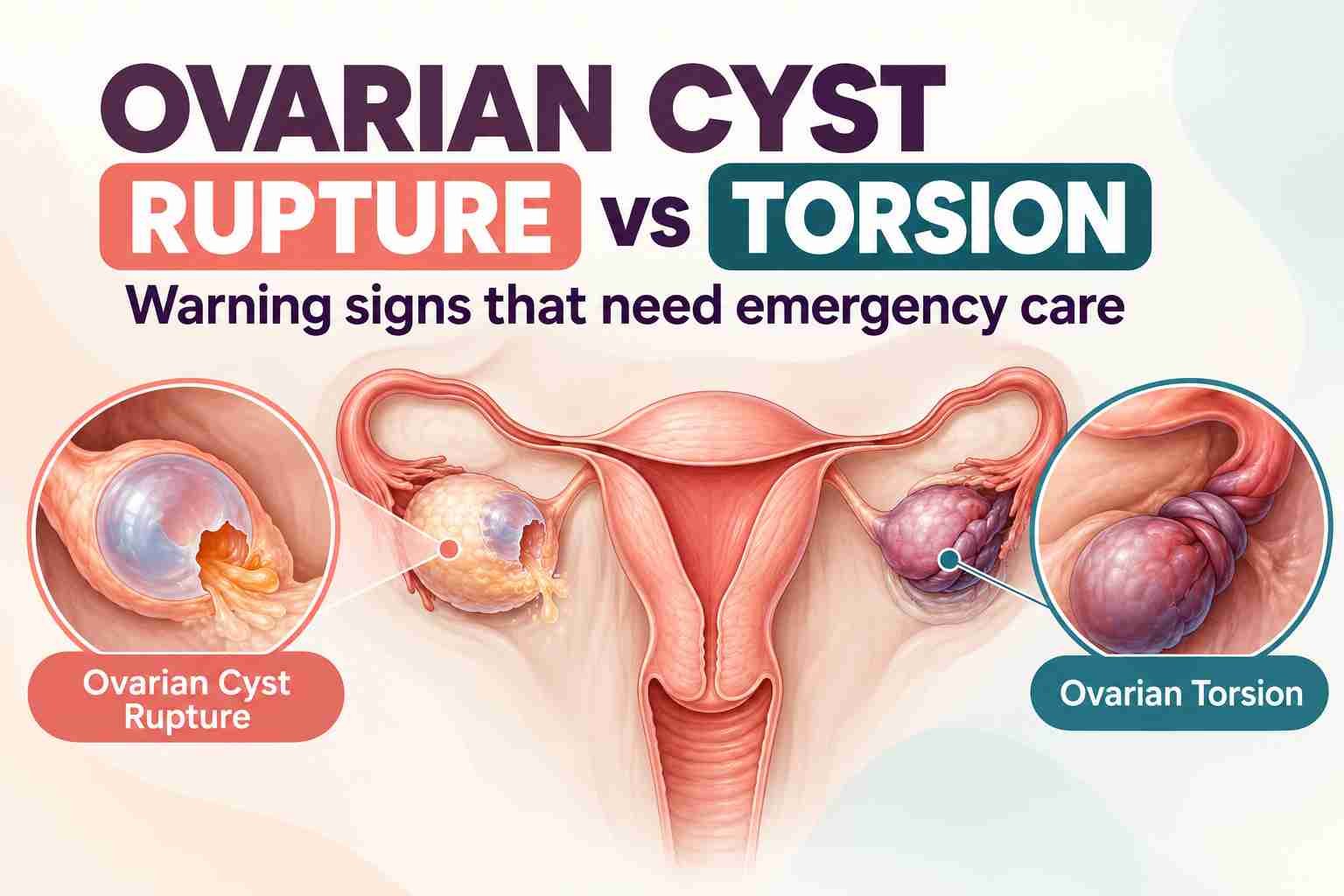
Quick summary
- Both start with sudden pelvic pain
- Rupture often settles with rest
- Torsion is a time-critical emergency
- Vomiting plus severe pain: go
- Early treatment can save the ovary
It’s 2 a.m. You’re lying in bed when a sudden, stabbing pain hits one side of your lower abdomen. You try changing positions. Maybe you get up and walk around. Nothing seems to help. Now you’re wondering whether you should take a painkiller and wait until morning or head straight to the emergency room. I know how frightening sudden pelvic pain can be, especially when you have no idea what’s causing it. Two conditions we worry about are a ruptured ovarian cyst and ovarian torsion. Both can cause sudden, sharp pain. Both may affect just one side of your pelvis. And early on, they can feel remarkably similar. But there’s an important difference. A small ruptured cyst may settle with observation and pain management. Ovarian torsion, on the other hand, happens when an ovary twists and its blood supply becomes restricted. It requires urgent surgical evaluation. If your pelvic pain is sudden and severe, don’t try to figure out which one you have at home. Go to the ER.
Ovarian Cyst Rupture vs. Torsion: The Short Version
Let’s start with a simple comparison.
| What to Know | Ruptured Ovarian Cyst | Ovarian Torsion |
| What happens | A cyst breaks open, releasing fluid or blood | The ovary twists around the tissues supporting it |
| Pain onset | Often sudden and sharp | Usually sudden and severe |
| Pain location | Commonly one side of the pelvis | Commonly one side of the pelvis |
| Nausea or vomiting | Possible, especially with severe pain | Common |
| Pain pattern | May gradually improve, but can remain severe | May be constant or come in waves |
| Main concern | Internal bleeding or irritation | Reduced blood supply to the ovary |
| Treatment | Observation or surgery, depending on severity | Urgent surgery to untwist the ovary |
The symptoms overlap enough that even an experienced gynecologist may need imaging, laboratory tests, and sometimes surgery to establish the diagnosis.
What Does a Ruptured Ovarian Cyst Feel Like?
Ovarian cysts are common, particularly during the reproductive years. Many develop naturally as part of ovulation and disappear without causing problems. Sometimes, however, a cyst breaks open. This is called an ovarian cyst rupture. A rupture can happen spontaneously. It may also occur during or after activities such as:
- Exercise or strenuous workouts
- Sexual intercourse
- Sudden physical movements
The pain often begins abruptly. You might feel a sharp sensation on one side of your lower abdomen, followed by a dull ache or lingering tenderness. Some women also experience bloating, pelvic pressure, or light vaginal spotting. Can the pain go away on its own? Yes. When a small cyst ruptures and there’s little bleeding, the body can gradually absorb the released fluid. Symptoms may improve over several days. But not every rupture is minor. Some cysts contain blood. When these hemorrhagic cysts rupture, they can cause bleeding into the abdomen. That may lead to worsening pain, dizziness, weakness, or fainting. Severe pain, fainting, or significant dizziness after a suspected cyst rupture requires emergency evaluation. For a confirmed uncomplicated rupture, rest and pain medication may be recommended. If you’re taking blood thinners or have kidney, stomach, or liver problems, ask your healthcare provider which pain relievers are safe for you.
What Does Ovarian Torsion Feel Like?
Ovarian torsion is different. Your ovaries are supported by tissues and ligaments that contain blood vessels. Sometimes, an ovary twists around these supporting structures. When that happens, blood flow can become restricted. Without timely treatment, the ovary may become damaged. The most common warning signs include:
- Sudden, severe pain on one side of the pelvis
- Nausea
- Vomiting
- Lower abdominal tenderness
- Pain that comes and goes
That last symptom is particularly important. Patients sometimes assume that if their pain improves, the problem must be resolving. Unfortunately, an ovary can occasionally twist and partially untwist. This can create episodes of intense pain followed by temporary relief. A break in the pain doesn’t rule out ovarian torsion. Torsion is more likely when an ovary is enlarged, particularly when a cyst or mass measures approximately 5 centimeters or more. However, torsion can occur with smaller cysts or even without an obvious cyst.
Who Is More Likely to Experience These Problems?
Ovarian cyst complications can happen to women who have never had pelvic problems before. Still, certain factors deserve attention. These include:
- A known ovarian cyst or ovarian mass
- Previous episodes of ovarian cysts
- Enlarged ovaries
- Fertility treatments that stimulate the ovaries
- Early pregnancy
- Endometriosis or certain other ovarian conditions
Fertility medications can sometimes cause the ovaries to become enlarged, increasing the risk of torsion.Pregnancy can also be associated with ovarian torsion, particularly during the first trimester. If you have a known ovarian cyst, I encourage you to ask your gynecologist which symptoms should prompt urgent evaluation. Most cysts never cause an emergency, but knowing what to watch for can help you act quickly if something changes.
When Should You Go to the ER?
This is the part I want every woman to understand. You don’t need to wait until you’re certain something is seriously wrong. Go to the emergency room immediately if you experience:
- Sudden, severe pelvic or lower abdominal pain
- Severe pain accompanied by repeated vomiting
- Fainting, significant dizziness, or unusual weakness
- A racing heartbeat with severe abdominal pain
- Heavy vaginal bleeding
- Severe pelvic pain with fever
- Sudden pelvic pain with a missed period or positive pregnancy test
That final point matters because an ectopic pregnancy can also cause sudden one-sided pelvic pain. An ectopic pregnancy develops outside the uterus and can cause life-threatening internal bleeding if it ruptures. Its symptoms can overlap with those of a ruptured ovarian cyst. If pregnancy is possible, emergency clinicians need to rule it out.
Where should you go?
For women in Barrington, Lake Barrington, and nearby communities, Advocate Good Shepherd Hospital is one local emergency care option. However, if you’re experiencing severe symptoms, the nearest appropriate emergency department is generally the best choice. Don’t spend extra time driving farther to reach a particular hospital. And if you’re faint, severely dizzy, or too unwell to travel safely, call 911 rather than driving yourself.
What Happens at the ER?
I know emergency visits can feel overwhelming, especially when you’re already in pain. The medical team will usually begin by checking your vital signs and assessing how stable you are. Several tests may follow.
- Pregnancy test – Even if you don’t think you’re pregnant, a pregnancy test is often necessary when evaluating sudden pelvic pain in someone who could become pregnant. This helps identify or rule out pregnancy-related emergencies.
- Blood tests – Bloodwork may be used to check for anemia, blood loss, or other concerns.
- Pelvic ultrasound – A transvaginal ultrasound allows clinicians to examine the ovaries and surrounding pelvic structures. It may show an ovarian cyst, free fluid suggesting rupture, or an enlarged ovary that raises concern for torsion.
- Doppler ultrasound – Doppler imaging evaluates blood flow in and around the ovary. But here’s something many patients don’t realize: Normal blood flow on Doppler ultrasound does not completely rule out ovarian torsion. The ovary has more than one source of blood supply, and twisting may be intermittent.
If the symptoms and examination strongly suggest torsion, surgery may still be recommended despite reassuring imaging.
How Is a Ruptured Ovarian Cyst Treated?
Treatment depends on how you’re feeling, your vital signs, imaging findings, and whether there’s evidence of significant bleeding. Mild, uncomplicated rupture If you’re stable and the bleeding is limited, treatment may involve:
- Observation
- Appropriate pain medication
- Rest while symptoms improve
- Follow-up imaging when needed
Your doctor may also recommend temporarily avoiding strenuous exercise or intercourse until your symptoms have settled. Severe rupture or internal bleeding. If there’s substantial bleeding, worsening pain, or unstable vital signs, hospital monitoring or surgery may be necessary. The goal is to control bleeding and treat the underlying problem while preserving healthy ovarian tissue whenever possible.
How Is Ovarian Torsion Treated?
Ovarian torsion requires urgent surgical treatment. There isn’t a medication that can reliably untwist an ovary. The usual approach is laparoscopy, a minimally invasive operation performed through small abdominal incisions. During surgery, the surgeon carefully untwists the ovary. This is called detorsion. Whenever possible, the goal is to preserve the ovary. If a cyst contributed to the twisting, the surgeon may also remove it when appropriate. Sometimes an ovary looks dark or swollen after torsion. That appearance alone doesn’t necessarily mean it cannot recover. For this reason, ovarian preservation is generally preferred when it’s medically appropriate.
How quickly does torsion need treatment?
As soon as possible. There isn’t a reliable number of hours after which an ovary is automatically lost. The outcome depends on several factors. But delaying treatment can increase the risk of permanent damage. That’s why suspected torsion is treated as a surgical emergency.
What Happens After the Emergency?
Once the immediate problem has been treated, I want to understand why it happened. Was there a functional cyst related to ovulation? Was the ovary enlarged? Have you had similar episodes before? Is there an underlying condition that needs attention? Follow-up may include reviewing your emergency records, discussing the ultrasound findings, and deciding whether repeat imaging or additional treatment is necessary. Most ovarian cysts are benign, and one rupture doesn’t automatically mean you’ll experience another. However, repeated cyst complications deserve a more detailed conversation. If you’ve recently been treated for a ruptured cyst or ovarian torsion, schedule a follow-up appointment with Dr. Shehrebanu Merchant to review your recovery and discuss any ongoing concerns.
Key Takeaways
- A ruptured ovarian cyst and ovarian torsion can both cause sudden, one-sided pelvic pain.
- Small, uncomplicated cyst ruptures may improve without surgery, but significant internal bleeding can be dangerous.
- Ovarian torsion occurs when the ovary twists and restricts blood flow.
- Severe pain with vomiting, fainting, or significant dizziness requires emergency evaluation.
- Normal Doppler blood flow doesn’t completely exclude ovarian torsion, and early surgery may help preserve the ovary.
Summary: Don’t Try to Diagnose Severe Pelvic Pain at Home
If there’s one thing I want you to take away from this article, it’s this: Sudden, severe pelvic pain is not something you should simply wait out. A ruptured ovarian cyst may eventually settle on its own. Ovarian torsion may not. And because the symptoms can look so similar, you cannot safely distinguish them without medical evaluation. If you’re experiencing severe pelvic pain, especially with vomiting, fever, dizziness, fainting, or a possible pregnancy, go to the emergency room. For ongoing ovarian cyst concerns, recurring pelvic discomfort, or follow-up after an emergency visit, I’m here to help. At my practice serving women in Barrington, Lake Barrington, South Barrington, and the greater Chicago area, we can review your symptoms, discuss appropriate testing, and develop a plan based on your individual needs. You deserve answers. And when the pain is severe, you deserve them quickly.
Frequently Asked Questions
How do I know if my ovarian cyst has ruptured?
A ruptured ovarian cyst often causes sudden, sharp pain on one side of the lower abdomen. You may also experience bloating, tenderness, or spotting. However, symptoms alone cannot confirm a rupture. Severe or persistent pain requires medical evaluation to rule out torsion, ectopic pregnancy, or other emergencies.
What does ovarian torsion feel like?
Ovarian torsion typically causes sudden, severe pelvic pain, often on one side. Nausea and vomiting are common. The pain may come in waves if the ovary twists and partially untwists. Even temporary improvement doesn’t rule out torsion.
Can a ruptured ovarian cyst heal on its own?
Yes. Many uncomplicated cyst ruptures resolve without surgery as the body absorbs the released fluid. However, significant internal bleeding can occur. Severe pain, dizziness, fainting, or worsening symptoms require emergency medical care.
How fast do I need treatment for ovarian torsion?
Ovarian torsion requires urgent surgical evaluation. There isn’t a guaranteed time window during which the ovary can be saved, but prompt treatment offers the best opportunity to preserve ovarian function. If torsion is suspected, go to the emergency department immediately.
Can ovarian torsion happen without a cyst?
Yes. Although torsion is more common when the ovary is enlarged by a cyst or mass, it can happen without one. This is particularly important in younger patients, but torsion can occur at different ages.