
You haven’t had a period in two years. Then one morning, you notice a little blood. Maybe it’s only a pink spot on the toilet paper. Maybe there’s enough to make you wonder whether your period has somehow returned. Either way, it’s unsettling. I want to start with the most important thing I tell my patients: if you’ve gone 12 full months without a period and then experience vaginal bleeding, it needs to be evaluated. Even once. Even if it’s barely there. That doesn’t mean you should immediately assume cancer. Most postmenopausal bleeding has a noncancerous explanation. But this isn’t a symptom I recommend watching for a few months to see what happens. Call your gynecologist and get it checked.
What Actually Counts as Postmenopausal Bleeding?
Menopause is reached after you’ve gone 12 consecutive months without a menstrual period. Once you’ve crossed that point, vaginal bleeding isn’t considered another late period.
Postmenopausal bleeding can look like:
- A tiny amount of spotting
- Pink discharge
- Brown or blood-tinged discharge
- Bright red bleeding
- Bleeding after sex
- A heavier flow that resembles a period
Patients sometimes tell me, “It was so little that I didn’t think it counted.” It counts. The amount of blood doesn’t tell us the cause, so even one light episode is worth mentioning.
What Causes Bleeding After Menopause?
Here’s the reassuring part: most cases aren’t cancer. After menopause, estrogen levels fall. That changes the tissues of the vagina and uterus and can make them thinner, drier, and more delicate.
Some common causes include:
- Vaginal or endometrial atrophy: Thin, fragile tissue can bleed easily, sometimes after intercourse.
- Uterine or cervical polyps: These are usually benign growths that can cause spotting or bleeding.
- Hormone therapy: Starting or changing menopausal hormone therapy can sometimes affect bleeding patterns.
- Endometrial hyperplasia: The uterine lining becomes too thick. Some types contain abnormal cells and need treatment.
- Fibroids: These benign uterine growths usually shrink after menopause, but they can occasionally contribute to bleeding.
- Infection or inflammation: Irritation involving the vagina, cervix, or uterus can sometimes cause bleeding.
So yes, there are plenty of noncancerous explanations. We just need to find out which one applies to you.
Why Do Gynecologists Take Postmenopausal Bleeding So Seriously?
Because sometimes it’s the first sign of endometrial cancer, which begins in the lining of the uterus. Roughly 1 in 10 women with postmenopausal bleeding may have uterine cancer , although the individual risk varies with age and other health factors. There’s another number I want women to know: about 90% of people diagnosed with endometrial cancer have experienced postmenopausal bleeding. That’s exactly why we pay attention to it.
Bleeding gives us an opportunity to investigate what’s happening rather than allowing a possible problem to remain unnoticed. And when endometrial cancer is identified early, treatment is often very effective.
Does the Bleeding Pattern Tell Us Anything?
It can give us clues, but it can’t give us a diagnosis.
- Amount : A few spots or light staining : Repeated or heavier bleeding
- Timing : Bleeding after intercourse from fragile vaginal tissue : Spontaneous bleeding without a clear trigger
- Frequency: A single episode : Bleeding that returns or continues
- Pain: No pain or mild irritation : Persistent pelvic or abdominal pain
- Other symptoms : Vaginal dryness or discomfort during sex: Unexplained weight loss, pelvic pressure, or worsening symptoms
- Risk factors: No major known risks : Obesity, diabetes, Lynch syndrome, certain hormone exposures, or strong family history
One warning about this table: Nothing in the “benign” column gives you permission to ignore the bleeding. A tiny spot can still require investigation. A large amount of bleeding can still turn out to have a benign explanation. The pattern helps me ask better questions. Testing gives us the answer.
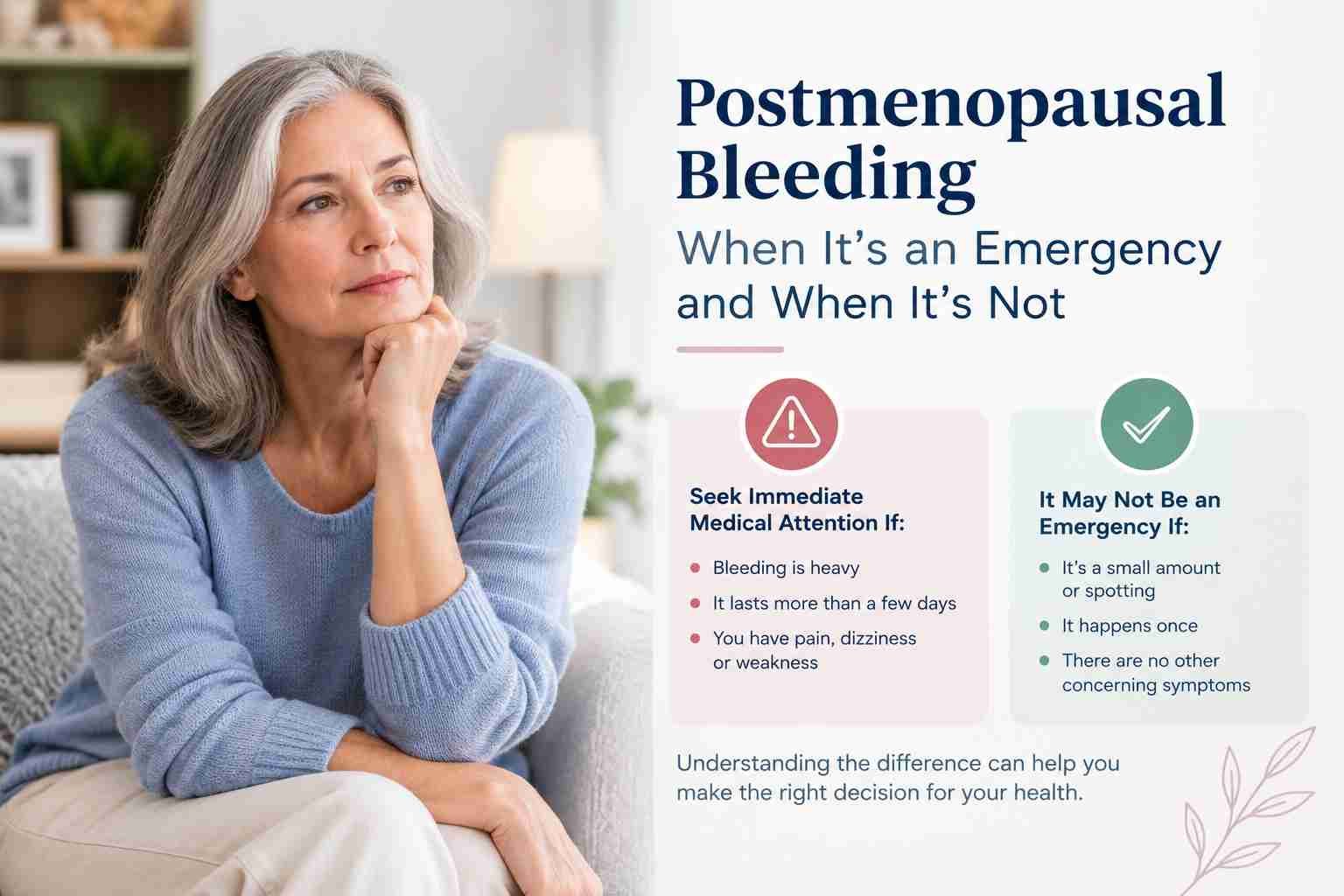
When Is Postmenopausal Bleeding an Emergency?
Most postmenopausal bleeding requires a prompt gynecology appointment , not necessarily an ambulance or emergency room visit. There are exceptions.
Go to the ER or seek urgent medical care if:
- You’re bleeding very heavily, such as soaking through a pad about every hour
- You feel faint, dizzy, confused, or extremely weak
- Your heart is racing or you feel short of breath
- You have severe abdominal or pelvic pain
- You develop fever or chills along with bleeding
- You’re taking a blood thinner and develop significant or uncontrolled bleeding
If you’re bleeding heavily and feel as though you might pass out, don’t drive yourself. Call 911.
How Do I Find Out What’s Causing the Bleeding?
This is where the evaluation becomes very individualized. I start by asking questions. When was your last period? How much are you bleeding? Is this the first episode? Are you taking hormone therapy? Blood thinners? Tamoxifen? Do you have pelvic pain? Has anything changed with your health recently? Then we examine.
- Pelvic examination – I’ll look at the vagina and cervix for possible sources of bleeding, including thinning tissue, irritation, infection, or a cervical polyp.
- Transvaginal ultrasound – A transvaginal ultrasound allows us to look at the uterus and measure the thickness of its inner lining. It can also identify findings such as polyps or fibroids.
- Endometrial biopsy – This is an important change in current U.S. guidance. For most patients with postmenopausal bleeding, current ACOG recommendations include endometrial tissue sampling along with transvaginal ultrasound in the initial evaluation. During an endometrial biopsy, a very small sample of the uterine lining is collected and sent to a laboratory. This helps us check directly for hyperplasia, precancerous cells, or cancer. The procedure is usually performed in the office and takes only a few minutes.
- Hysteroscopy, if needed – Sometimes we need a better look inside the uterus. A hysteroscopy uses a thin camera that passes through the cervix so we can see the uterine cavity directly. It can be particularly helpful when we’re looking for a polyp or when bleeding continues despite an earlier reassuring evaluation.
What Happens If We Find the Cause?
Then we treat that cause. There’s no single treatment for postmenopausal bleeding.
For example:
- Vaginal atrophy may be treated with vaginal moisturizers, lubricants, or local vaginal estrogen when appropriate.
- Polyps can often be removed with a minor procedure.
- Infection may require medication.
- Hormone-therapy-related bleeding may require reviewing or adjusting the treatment plan.
- Endometrial hyperplasia may be treated with progestin or, depending on the type and individual circumstances, surgery.
- Endometrial cancer is usually managed by a gynecologic oncologist, with surgery often forming an important part of treatment.
The treatment decision should come after we understand why you’re bleeding. Please Don’t Minimize “Just a Little Spotting” Women are very good at putting their own health on hold. Work is busy. Family needs something. Chicago traffic makes an appointment feel like an afternoon project. And when the bleeding stops, it’s tempting to think, Maybe I don’t need to go anymore. Please still go. Postmenopausal bleeding is one of those symptoms where a relatively simple evaluation can provide enormous reassurance—or identify a problem while we have an opportunity to address it early. At my South Barrington practice, we can evaluate abnormal bleeding and determine whether you need ultrasound, endometrial sampling, hysteroscopy, or another form of care. You don’t need to panic. But you shouldn’t wait and see either.
Key Takeaways
- Menopause means 12 consecutive months without a menstrual period.
- Any vaginal bleeding after that point is considered abnormal.
- Most postmenopausal bleeding has a benign cause.
- Around 90% of patients with endometrial cancer have postmenopausal bleeding.
- Current ACOG guidance recommends ultrasound plus endometrial tissue sampling in the initial evaluation of most patients.
- Heavy bleeding, fainting, severe pain, or other signs of significant blood loss require emergency care.
Frequently Asked Questions
Is light spotting after menopause really worth seeing a doctor for?
Yes. Even a single episode of light spotting after menopause should be discussed with your gynecologist. The amount of bleeding doesn’t reliably tell us whether the cause is harmless or needs treatment.
What percentage of postmenopausal bleeding is caused by cancer?
Estimates vary depending on age and individual risk factors, but approximately 10% of women with postmenopausal bleeding may have uterine cancer. Most cases have another explanation.
Can hormone replacement therapy cause bleeding after menopause?
Yes. Bleeding can occur after starting or changing menopausal hormone therapy. Still, don’t automatically blame the medication. New, persistent, or heavy bleeding should be discussed with your healthcare provider.
What tests are used to check for endometrial cancer after postmenopausal bleeding?
Current ACOG guidance recommends transvaginal ultrasound combined with endometrial tissue sampling as part of the initial evaluation for most patients with postmenopausal bleeding. Hysteroscopy or additional testing may be needed depending on the findings or if bleeding persists.
How quickly should postmenopausal bleeding be evaluated?
Contact your gynecologist promptly rather than waiting for your next annual visit. If you’re experiencing heavy bleeding, fainting, severe pain, fever, significant weakness, or other concerning symptoms, seek urgent or emergency medical care.